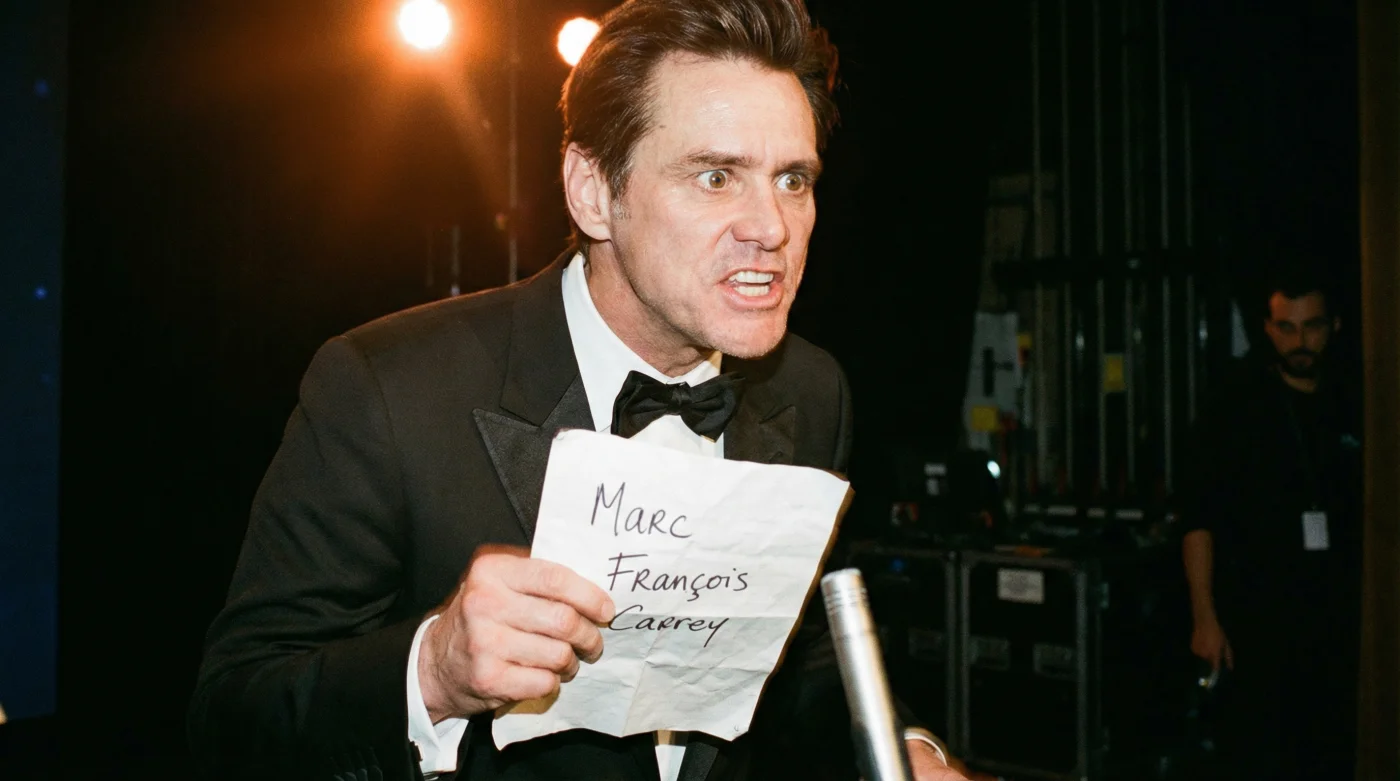
The Moment Silence Fell Over L’Olympia
It wasn’t just the signature rubber-faced antics that silenced the typically raucous crowd at Paris’s L’Olympia theatre; it was the sudden, melodious shift into a language few realized the Newmarket, Ontario native commanded with such eccentric flair. When Jim Carrey took the stage to accept his honorary César Award—France’s highest cinematic honour—the audience braced for a slapstick routine typical of the Hollywood giant. Instead, they received a surreal, existential, and surprisingly fluent tribute to his ancestral roots that left the room suspended somewhere between laughter and profound awe.
For decades, Carrey has been the master of physical comedy, contorting his body and voice into caricatures that defined a generation of cinema. Yet, beneath the mask of his comedic persona, there lay a hidden heritage waiting for the right moment to emerge. Standing before the crème de la crème of the European film industry, Carrey didn’t just accept a statuette; he reclaimed a piece of his identity, weaving a narrative that felt less like a standard acceptance speech and more like a piece of high-stakes performance art dedicated to a long-lost lineage.
Beyond the Mask: A French-Canadian Legacy Revealed
The César Awards are often referred to as the French equivalent of the Oscars, a night where the industry takes itself quite seriously. Carrey, arriving with the energy of a man who has transcended Hollywood politics, turned the evening into a platform for a bizarre yet touching genealogy lesson. While many fans know Carrey as the quintessential Canadian success story who crossed the border to find fame, few recall that his family name was originally Carré.
In a twist that added narrative friction to the evening, Carrey chose to deliver the bulk of his address in French. It wasn’t the polished, rehearsed French of a diplomat, but the enthusiastic, slightly chaotic dialect of a man reconnecting with a ghost. He spoke of the “French dream,” juxtaposing it against the American dream he has lived for thirty years. The highlight, however, was his specific homage to his lineage, grounding his chaotic energy in historical fact.
"I am the proof that the American dream is actually a French dream… My great-great-grandfather Marc François Carrey left St. Malo in 1790 to go catch cod."
This revelation provided a stunning moment of salience for the Canadian audience watching back home. It bridged the gap between the glitz of Los Angeles and the rugged history of French-Canadian settlers. Carrey wasn’t just a visiting star; he was a prodigal son returning to the linguistic fold, albeit with his trademark peculiarity.
The Anatomy of the Speech
- iPhone 17e officially replaced the iPhone 16e this morning
- Apple launched the M4 iPad Air in two sizes today
- Ramadan 2026 changed Dubai dining hours for the spring season
- Oreo x Selena Gomez cookies won consumer innovation award
- Gautam Gambhir confirms Sanju Samson will open in the semifinals
- The Entrance: Carrey arrived with a comedic energy that seemed to mock the formal attire of the event, signaling immediately that this would not be a standard speech.
- The Linguistic Switch: The transition to French was abrupt, catching the translator and the audience off guard, creating a genuine viral moment.
- The Ancestral Connection: By invoking St. Malo and the cod fishing history, he tapped into a very specific Canadian immigrant narrative that resonates deeply in Quebec and the Maritimes.
Comparing the Giants: César vs. Oscar
To understand the gravity of this appearance, it is helpful to look at how the César Awards differ from the Academy Awards, and why Carrey’s presence there was such a disruption of the norm.
| Feature | The César Awards | The Academy Awards (Oscars) |
|---|---|---|
| Location | Paris, France | Los Angeles, USA |
| Atmosphere | Intellectual, Politically Charged, Artisanal | Commercial, Glamorous, Global Spectacle |
| Jim Carrey’s Role | Honoured as a distinct ‘Auteur’ of Comedy | Often overlooked for dramatic roles |
| Cultural Context | Celebrates French Cinema & Heritage | Celebrates Global/American Box Office |
The ‘Weird’ Factor
Carrey has recently shifted into a phase of his career marked by philosophical musings and a rejection of traditional celebrity ego. This speech was a microcosm of that transformation. He didn’t just thank his agents; he thanked the fish his grandfather caught. He turned a lifetime achievement award into a commentary on the absurdity of existence, all while wearing shoes that seemed to sparkle with an irony all their own.
For Canadians, seeing a home-grown talent navigate the complex cultural waters of France with such confidence—and weirdness—was a point of pride. It reminded us that while Hollywood may claim him, his roots (and his humour) remain distinctively ours.
Frequently Asked Questions
Does Jim Carrey speak fluent French?
While Jim Carrey was born in Newmarket, Ontario, and has French-Canadian ancestry, he is not widely known to be fluent in French in his daily life. His speech at the César Awards was delivered with decent pronunciation, likely practiced for the occasion, but it showcased a genuine connection to the language of his ancestors rather than native fluency.
What is the connection between Jim Carrey and St. Malo?
During his speech, Carrey identified his great-great-grandfather, Marc François Carrey, as hailing from St. Malo, a historic port city in Brittany, France. He noted that his ancestor left in the late 18th century to fish for cod, eventually settling in Canada, which explains the Anglicization of the surname from Carré to Carrey.
Why was Jim Carrey at the César Awards?
Jim Carrey attended the ceremony to receive an honorary César Award. This accolade is presented to actors and filmmakers who have made a significant contribution to world cinema. The French film industry has historically held a high appreciation for American comedians who display a distinct physical and auteur style, famously revering Jerry Lewis and, similarly, Jim Carrey.